
A Turning Point for the Middle East
Ryan Parada • November 12, 2025
President Donald J. Trump Welcomes Syria’s Ahmad al-Sharaa to the White House
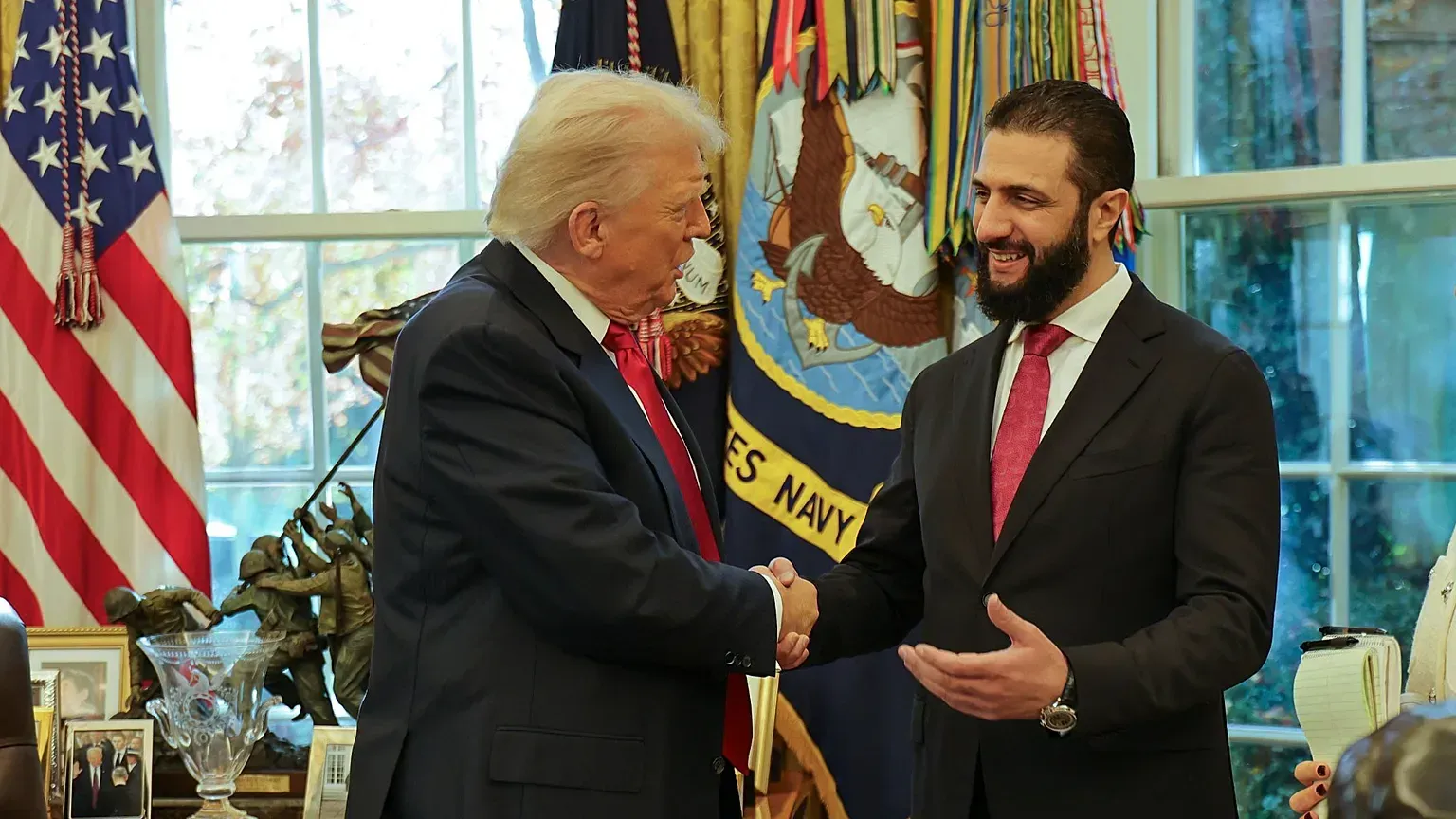
On November 10, 2025, something happened in Washington, D.C. that just a few years ago would have sounded very unlikely. The Syrian President visited the White House for a private meeting with President Donald J. Trump. There was no grand press ceremony, no choreographed moment for cameras, and no dramatic speech at the podium. Instead, the two leaders met behind closed doors to discuss cooperation against ISIS and the possibility of a new security agreement between Syria and Israel. Quiet, careful, but historic all the same.
For decades, relations between the United States and Syria have been defined by mistrust and distance. The Syrian Civil War deepened that divide, and the rise of ISIS created chaos that spread across the region. Yet today, the ground is shifting. The defeat of ISIS as a territorial force was a major change, but the threat has not disappeared. The challenge now is preventing the group from rebuilding and preventing another power vacuum from forming. This is where President Trump’s approach comes in. He has always been a believer in direct conversation; he is a deal-maker after all. If you want stability, you do not ignore the people who hold power. You work with them and shape a better outcome through the deal itself.
Much has already been said about President Ahmad al-Sharaa’s past. He was once listed as a global terrorist. He has now been removed from both United States and United Nations terrorist designations after internal reviews, intelligence reassessments, and sustained diplomatic dialogue. President Trump’s administration has made it clear, what matters in foreign policy is not who someone used to be, but who they are now and what direction they want their country to move toward. Syria is exhausted by war. Its leadership has incentives to rejoin international systems rather than remain isolated. That opens the door for a new relationship built on practical goals.
The first priority is clear. Syria will join the U.S. led coalition against ISIS. That move would strengthen intelligence sharing, border control, and coordinated military pressure on extremist cells operating across Syria, Iraq, and neighboring regions. The coalition has always been strongest when regional states are willing to participate directly rather than stand on the sidelines. Bringing Syria in is a step toward lasting stability.
The second topic discussed is even more significant, though it has received less attention. The United States is exploring a potential security agreement between Syria and Israel. The Syrian-Israeli border has been one of the most tense fault lines in the Middle East since the middle of the twentieth century. Entire generations have grown up assuming that hostility across that border is permanent.
But history is not static. Interests change. Needs change.
Syria wants reconstruction, economic relief, and international recognition. Israel wants a stable and secure northern border without the constant risk of escalation. The United States wants to prevent the return of terrorism and reduce the likelihood of new wars in the region. Everyone has something to gain. The possibility of an agreement does not mean instant peace. But it does mean that the conversation is finally happening.
President Trump’s critics often misunderstand his approach to diplomacy. He is not looking for applause or dramatic gestures. He is looking for results. Real negotiations happen away from cameras because cameras encourage performance. The quiet nature of this meeting suggests serious intent on both sides. There was no need to broadcast it. The work itself is what matters.
If progress continues, this moment may later be seen as the beginning of a new chapter for Syria, Israel, and the Middle East. A chapter defined by reconstruction instead of ruin. A chapter defined by coalition and cooperation rather than endless conflict. No one is pretending the past was simple. But the future does not need to repeat the past.
The Middle East has seen decades of war, resentment, and distrust. It has also known brief but powerful moments when the impossible suddenly becomes possible. Peace treaties once considered unthinkable were signed. Leaders who once faced each other only through threats sat face to face and shook hands. Those breakthroughs did not come from refusing to talk. They came from the willingness to try, and President Trump is a deal maker, he wants to get all parties in the same room and work out even the most complex issues, not looking back, but always facing forward.
The meeting between President Trump and President al-Sharaa is not the end of the story. It is the beginning of the next attempt to build something better. And for the first time in a long time, there is reason to believe that Syria’s future can be shaped by stability, cooperation, and rebuilding, rather than constant crisis.
Hope may be returning to a place where hope has been missing for too long.
Ryan Parada is a Partner and the Chief Government Affairs Officer for Connector, Inc. where he oversees both domestic and international portfolios. He is a policy expert for our clients in numerous areas, including national security, energy, and the tobacco industry.