
Lighting Him Well
While the world rewards visibility, there is still a profession that demands the opposite.
Nobody teaches kids today to aspire to a job where doing it perfectly means no one ever knows you did it. Every incentive in American life now runs the other direction: build the following, secure the platform, make sure the work carries your name somewhere visible enough to count. Advance work — the practice of making a politician or elected official’s trip, from arrival to departure, look like it happened without any effort at all — asks for exactly the opposite. And it is worth asking why anyone still signs up for the job.
The answer is simple: for some of the most proficient operatives in American politics, anonymity is the entire design.
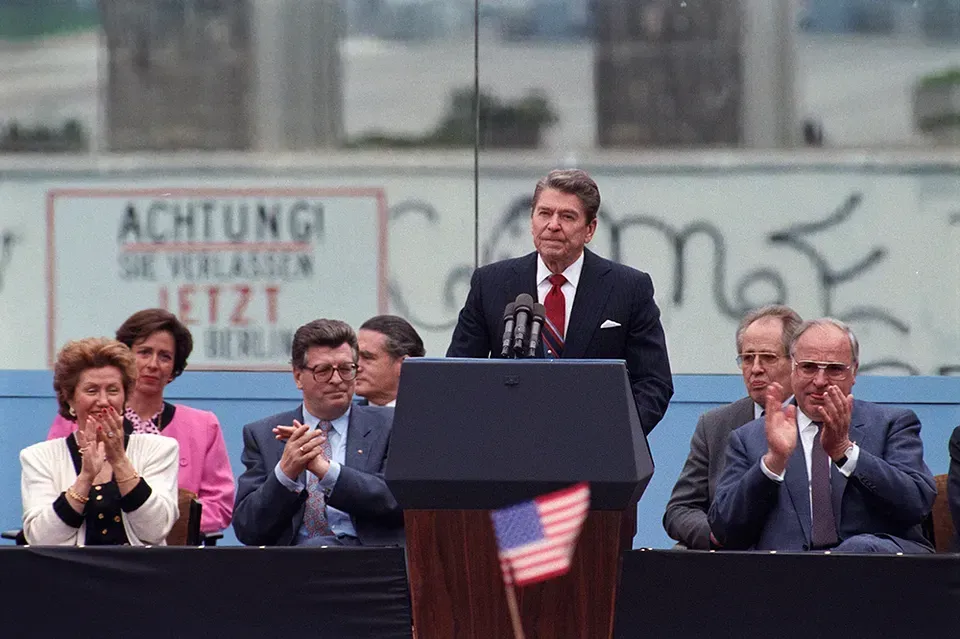
President Ronald Reagan’s reputation as the most visually gifted president of the modern era (save for maybe President Donald J. Trump) was not Reagan’s achievement alone. Behind it stood Michael Deaver, the White House Deputy Chief of Staff who helped shape the imagery of the Reagan presidency — and who was regarded, depending on whom one asked, as either a genius of political stagecraft or the man who taught Washington that a picture could overpower the substance behind it. Both descriptions pointed to the same truth: Deaver’s success depended upon his remaining invisible. The moment he entered the frame, the frame ceased to work.
Deaver selected the cliffs at Pointe du Hoc. He chose the spot along the wall in Berlin. He built the backdrop of a hundred more moments most Americans could still describe without being able to say who created them, and when people finally tried to hand him credit late in his life, he turned it down in the plainest terms he had. “I’ve always said the only thing I did is light him well,” Deaver would respond. “I didn’t make Ronald Reagan. Ronald Reagan made me.”
He was wrong about that . . . but the instinct behind the sentence was exactly right anyway, because it is the instinct the entire advance operations profession runs on. The job succeeds precisely to the degree that nobody can prove it happened.
That instinct is getting harder to find and not because the skill has gotten harder to teach. It is because we have spent two decades building a culture that treats being seen as a form of proof — proof of relevance, proof of value, proof the work occurred at all. A young staffer today can build a career, and an audience, from behind a keyboard or from in front of a camera faster than it takes to learn how to properly choreograph a principal’s movement through back-of-house hallways, or lay out bike rack so a crowd moves exactly the way they’re supposed to instead of the way they want to. Nobody goes viral for confirming a motorcade route. Nobody gets a cable hit for finding the one loading dock wide enough to fit three satellite trucks. The work still has to happen . . . it has simply stopped being the work anyone is trained to want.
That is exactly why the work behind the curtain matters more now, not less. In a culture built entirely around being witnessed, a person willing to do excellent, difficult, invisible work is not a throwback. They are a check against the whole premise of the age — proof that some things are still worth doing correctly even when no one will ever know who did them. The less anyone wants the job, the more valuable the ones still willing to take it become.
Somewhere today, someone is walking a site that will matter a great deal to many people tomorrow. They are rechecking sightlines nobody asked them to check twice, confirming a timeline nobody will ever know existed, and ensuring that the throw from the bullnose is the exact distance they planned for. If they do it right, their names will never come up. Deaver would have told these invisible professionals that’s the whole point. And Deaver, whatever else he got wrong about his importance, was right about that.
We will always need people willing to disappear into the work . . . especially in an age that has forgotten how.
Rob Burgess is a national Republican strategist, and Chief Executive Officer at Connector, inc. — a boutique government relations, public affairs, and political strategy firm with offices in Washington, D.C.