
Targeting Law Enforcement Isn't Protesting
Robert Burgess • January 12, 2026
The intolerant left continues to demonstrate to the American people their complete lack of understanding of federal law and their unveiled contempt for the majority of Americans.
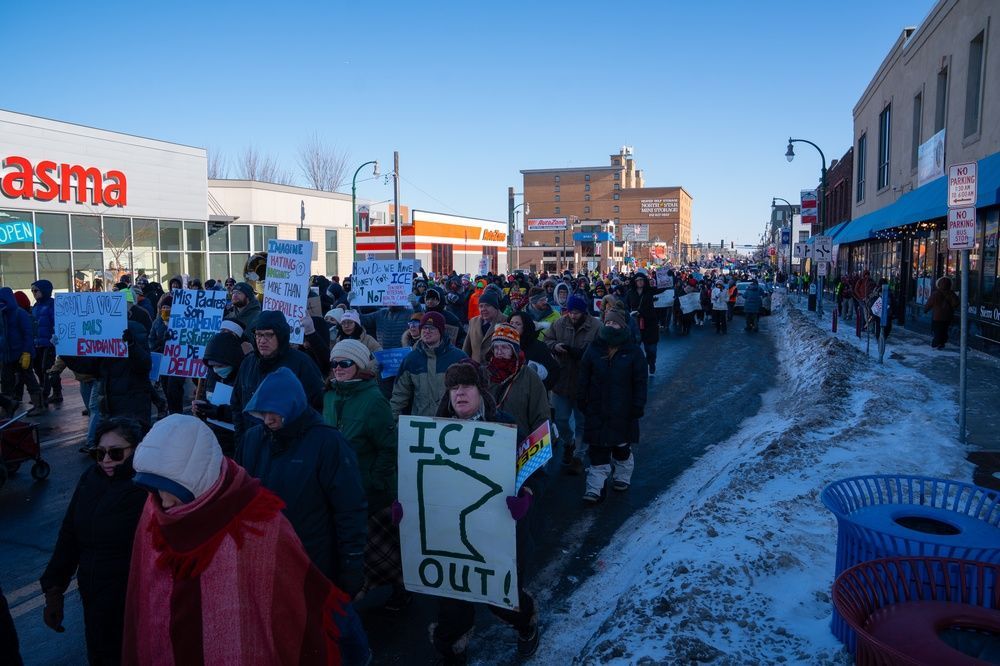
In Minneapolis and far beyond, what the national media are dutifully labeling “protests” are in truth coordinated campaigns of disruption, intimidation, and — in too many cases — outright violence against the men and women of Immigration and Customs Enforcement (ICE) and their federal partners. If this were merely a matter of civilians exercising free speech, none of us would be talking about blocking federal vehicles, attempting to dox agents, denying basic services such as shelter and food, or endangering lives during enforcement actions.
But this is not peaceful dissent. This is organized obstruction of justice, mob intimidation, and a dangerous erosion of the rule of law — egged on, emboldened, and normalized by elected Democratic officials who should instead be de-escalating tensions and upholding public safety.
The spark for this latest round of unrest was the fatal shooting of 37-year-old Renee Nicole Good by an ICE agent in Minneapolis on January 7, 2026, during an immigration enforcement operation. Federal authorities have stated unequivocally that Good tried to weaponize her vehicle against ICE personnel — a claim which multiple videos online seem to support — attempting to strike officers with her SUV. This prompted the ICE agent’s use of defensive force in the face of a clear threat. Federal sources have likened Good’s actions to domestic terrorism.
Yet within hours, the narrative was seized upon and repacked by political leaders who should know better.
Minneapolis Mayor Jacob Frey, a Democrat, has stoked division and fortified anti-law enforcement fervor. In the immediate aftermath of the shooting, Mayor Frey publicly rejected the federal account of the incident and blasted the notion that the ICE agent acted in self-defense as “bulls---,” accusing federal authorities of “hiding facts” and undermining public trust.
From the steps of Minneapolis’ City Hall, the mayor didn’t call for cooler heads to prevail. He didn’t encourage cooperation with the ongoing investigation. He didn’t emphasize due process or the presumption of innocence. Instead, he told ICE unequivocally to “get the f--- out of Minneapolis” — a blunt political statement from a municipal leader that, in context, amount to urging federal law enforcement to withdraw under pressure.
Make no mistake Mayor Frey’s incendiary rhetoric was a rallying cry that effectively painted ICE agents — sworn officers tasked with enforcing the law — as unwelcome outsiders whose presence “causes chaos and distrust.” Not to mention, he lacks the authority to kick federal law enforcement out of Minneapolis.
That is not leadership. It is demagoguery.
And it has consequences.
Prior to reports of agents being physically attacked and their operations interfered with, there were voices in power deliberately misframing the situation. Minnesota’s attorney general and governor echoed similar sentiments, casting Good as a “legal observer” and immediately demanding ICE depart the state.
The problem, of course, is that law enforcement does not operate in a vacuum. When “legal observers” hinder, interfere, or disrupt law enforcement they’re committing a crime and are no longer passive watchers. When political leaders publicly challenge the legitimacy of federal operations and characterize trained agents as villains (before the ink is dry on an official investigative report), they are stoking the very environment in which people feel justified in obstructing justice. These elected officials are signaling to radicals and agitators that pushing, block, surveilling, heckling, and even attacking agents isn’t just permissible . . . it’s righteous.
And once that signal is sent, the predictable happens.
In cities where ICE has been carrying out enforcement operations (not just Minneapolis), there have been verified reports of protestors, surrounding and blocking law enforcement vehicles, standing between agents and their duties, and, most alarmingly, creating physical obstructions that endanger officers and civilians alike. These are not public statements of grievance or the actions of “legal observers” . . . these are acts of interference with federal law enforcement. These actions have legal consequences and place officers at risk. The law is clear: obstructing an enforcement action is not protected speech; it is a violation of federal law.
This is not semantics. It is reality. And the intolerant left wing protestors are learning it the hard way.
Every law enforcement officer — whether a local cop or a federal immigration agent — swears an oath to uphold the Constitution, and enforce the law impartially and without fear or favor. But that oath also binds government to protect those who serve. There is no nobility in sending officers into harm’s way while political leaders casually dismiss their safety as a secondary concern.
Let’s be clear: law enforcement has the legal and moral authority to protect themselves and others. When a suspect attempts to run down a trained federal agent, when hostile crowds block vehicles and create combat conditions, officers are legally justified (and required) to take necessary action to neutralize the threat. That’s not brutality. It is survival. Considered precedent, both legal and practical, affirms that law enforcement may use force to ensure their own safety and the safety of others when confronted with imminent physical danger. The duty to return home at the end of each shift uninjured is not a privilege, but a fundamental human right.
This is nonnegotiable. And yet, what do we hear from certain elected Democrats? Rhetoric condemning agents, calls for withdrawal, and narratives that implicitly encourage radicals to step between an officer and the law they are sworn to enforce.
The contrast could not be starker.
One the one hand, we have federal law enforcement officers acting under the rule of law, attempting to execute an operation rooted in statue passed by Congress. On the other hand, we see protests that go far beyond peaceful expression: coordinated efforts to follow agents, harass them at hotels and restaurants, and undermine their ability to function as officers.
There have been reports of ICE agents being turned away from lodging because local establishments, under pressure from activists, refused service due to their enforcement actions . . . a tactic designed to isolate, shame, and demoralize agents. There have been unverified but widely circulated claims online about posting personal information, a tactic understood colloquially as “doxing,” that puts agents and their families at risk. And all too often this harassment and intimidation is encouraged or excused by sympathetic public officials and media personalities. Nowhere is this more reckless than when elected leaders portray enforcement actions as inherently illegitimate, even criminal.
It is a foundational principle of American law (even in Minneapolis) that guilt must be established based on evidence, not emotion. Yet in Minneapolis, we’ve seen a troubling inversion: immediately after the unfortunate shooting, local leaders and activists groups leapt to demonize the agent involved. Statements lobbed at federal authorities from City Hall accused them of hiding facts and spreading misleading information, all while downplaying the violent context that precipitated the use of defensive force.
No one is above scrutiny. No agency should be exempt from honest and transparent investigations. But there is a glaring difference between demanding facts and weaponizing tragedy for political advantage — especially when that political advantage is a rallying cry that further endangers officers and deepens societal divides.
What is happening in Minneapolis is part of a broader national pattern. Protests that begin as seemingly peaceful gatherings against federal enforcement — like the events reports across other cities after immigration operations — have repeatedly devolved into clashes with police, disruption of lawful activity, and obstruction of legal authority. Similar flare-ups have occurred in places where federal agents have attempted enforcement actions, with protestors blocking entrances, challenging officers, and in some cases engaging in violence.
And every time, there are local and state politicians ready to provide rhetorical cover, framing federal efforts as unjust or illegitimate, while placing blame for unrest squarely on the officers whose lawful duties were being impeded.
It has previously been reported that George Soros and his Open Society Foundations have funneled significant sums of money into left-wing advocacy and activist networks, including groups that have been visible at high-profile demonstrations and disruptive protest campaigns across the country. Public reporting from outlets such as the New York Post highlights that organizations like Indivisible Twin Cities — identified as a driving force behind Minneapolis’ anti-ICE actions — trace millions of dollars in past grant support to Soros-linked philanthropy, and that similar progressive coalitions have received sizeable funding from Soros-backed entities and allied “dark money” networks in recent years.
Given this documented flow of philanthropic dollars into activists infrastructures that frequently organize, coordinate, and sustain large-scale protests that often utilize tactics that stray from from peaceful assembly, it is reasonable to ask a hard question: could the current spate of immigration and ICE-related confrontation be part of that same pattern of organized, well-funded left-wing protest activity? As Americans watch federal agents be targeted and harassed, that question is not merely academic, it is a necessary part of understanding who is driving and sustaining today’s unlawful protests.
This is a destabilizing dynamic that must be called out for what it is: an assault on the rule of law itself and a stain on the fabric of our Republic.
Leadership demands more than sound bites and social media posts. Real leaders seek to calm tensions, uphold the law, and work towards solutions that respect both the rights of citizens and the safety of those charged with enforcing the law. When an officer is attacked with a vehicle, it is the time for unequivocal defense of law enforcement and the institutions that keep our society functioning. Anything less emboldens radicals who see violence and obstruction as viable tools for political ends. Let’s be clear: this is not a debate about immigration policy writ large. This is a debate about whether the law means anything at all in America.
ICE agents don’t create or enact federal immigration laws; they enforce them. They do so under statutory authority, with due process procedures in place, and with the expectation that officers will act judiciously and proportionately. And when hostile individuals escalate into physical threats, the agents are legally entitled (and morally justified) to protect themselves and others.
What we are witnessing from far too many Democrat elected leaders is a discouraging repudiation of this basic principle. Demanding accountability is not the same as excusing obstruction. Defending constitutional rights does not mean endorsing intimidation. And questioning federal authority does not mean telling federal law enforcement to pack up and go home while mobs patrol the streets. Democratic officials who stoke the fire of political unrest are complicit in the degradation of lawful order.
The United States of America is not a failed nation state. We have a Constitution, a system of laws, and a justice system designed to handle disputes — including those that involve federal enforcement actions — that are the envy of the entire world. But these systems rely on cooperation, discipline, and respect for process. They do not function when elected officials reduce complex situations to catchy slogans and inflammatory sound bites.
If our national debate descends into a contest of who can vilify the other side more effectively, then we have lost far more than an immigration enforcement operation — we have lost the rule of law. It is time for serious leaders, regardless of party, to stand up for that principle rather than tearing it down for short-term political gain.
Rob Burgess is a national Republican strategist, and Chief Executive Officer at Connector, Inc. – a boutique government relations and political affairs firm with offices in Washington, D.C.