
We Built the Atomic Bomb for Less Than This
Chris Faulkner • January 6, 2026
California has once again proven they are the undisputed home of America's greatest boondoggles.
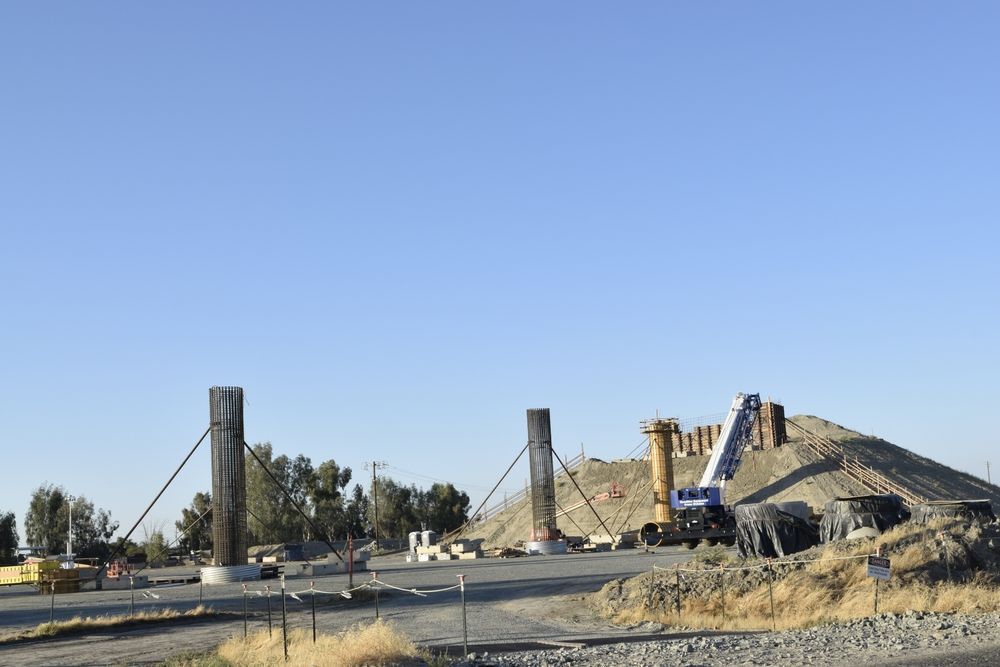
There is a line that should stop every taxpayer cold: California’s high-speed rail project, still nowhere near complete, is now projected to cost more than five times what the United States spent to build the atomic bomb. Not metaphorically. Not rhetorically. Literally.
The Manhattan Project, the massive wartime effort that invented nuclear weapons, cost roughly $2 billion in 1940s dollars which is, depending on what measurement you look at, between $25 billion and $30 billion today. California’s bullet train — sold to voters at $33 billion, is now barreling toward $128 billion and climbing, while the promised San Francisco to Los Angeles line remains a dream with reams and remas of excuses attached.
Transportation and infrastructure are supposed to be nation-building investments. They’re supposed to create economic mobility, faster commerce, energy independence, and strategic value. But in America today, they’ve metastasized into something else entire: slow, bloated, fabulously expensive monuments to dysfunction.
And California’s rail boondoggle isn’t an outlier . . . it’s the rule.
Consider just a few examples:
- Boston’s “Big Dig” was supposed to be a roughly $3 billion modernization of the city’s core highways. It ended up at nearly $15 billion, swallowed decades of time, triggered corruption probes, and inspired an entire generation of officials to lower expectations on behalf of their constituents.
- Honolulu’s 20-mile rail line began as a $5 billion local mobility project. It’s already blown past $12 billion, making each mile one of the most expensive rails on earth, funded by a relatively small local tax base that never voted for this level of financial punishment.
- In New York, the East Side Access project — designed simply to allow Long Island Railroad trains to reach Grand Central Station— cost north of $11 billion and arrived more than a decade late. Meanwhile, Phase One of the Second Avenue Subway delivered just 1.8 miles of track for roughly $4.5 billion, or $2.5 billion per mile . . . up to 12 times what comparable cities pay.
Even when we head outside of transportation, the pattern doesn’t change.
The Aurora VA hospital in Colorado ballooned from a few hundred million dollars to roughly $1.7 billion, proving that even when the mission is sacred — caring for veterans — government mismangement can turn heroism into paperwork.
Healthcare.gov, the website meant to demonstrate the competence of modern centralized health policy, exploded into a near $2 billion ordeal before it even worked properly.
Our own defense bureaucracy has become addicted to this culture of escalation as well. The F-35 fighter program (insert a deep breath here)
intended to be an affordable, standarized jet . . . is now projected to cost over $2 trillion across its life cycle, while readiness rates remain embarrassingly low. Also, to add salt to the wound, the Air Force mechanic who works on this monstrosity only makes about $40,000 per year.
NASA’s Space Launch System, a rocket built like a federal jobs program with boosters, has absorbed tens of billions of dollars and costs around $4 billion per launch at precisely the moment private innovators are cutting that number by factors, not precentages.
And if you want a tragicomic case study . . . remember Denver’s infamous automated airport baggage system? Hundreds of millions spent on a machine so unreliable, city eventually shut it off and hired humans to do the job.
This isn’t about “government bad.” It’s about a government that has forgotten how to build.
America once laid transcontinental railroads in less time than it now takes to file environmental paperwork. It once dredged rivers, raised interstate highways, built the Hoover am, erected the Empire State Building in 13 months, landed astronauts on the moon, and industrialized an entire nuclear weapons complex . . . faster, cheaper, and with higher national purpose than we can now deliver a rail line from Bakersfield, CA to Merced, CA.
The problem isn’t ambition. Ambition built America.
The problem is bureaucratic sprawl, overlapping regulatory vetoes, union and contractor capture, endless litigation, political pork, and a total lack of accountability. It is not surprising that projects are expensive. It is shocking that they are this expensive.
And here’s the political truth that no one wants to say out loud: every runaway project erodes faith in government itself. When citizens see $100 billion train lines that never arrive, $10 billion tunnels to move commuters a few blocks, $2 trillion fighter jet programs that barely fly, and $50 billion rockets that are obsolete before launch, they don’t see “investments.” They see a system that takes, delays, blames, and shrugs.
We need to do big things. America deserves bold transportation, world-class infrastructure, and future-defining engineering. But right now, we don’t lack imagination . . . we lack spine. Spine to simplify laws. Spine to streamline approvals. Spine to cap costs and fire incompetent managers. Spine to say “no” when projects drift into lunacy.
If California’s high-speed rail ever fully opens, it may move people. But right now, it moves something far more powerful — cynicism. And unless we change course, the next time government promises to reshape the future, Americans will assume the only thing being reshaped is the taxpayers’ wallets.
We can build big again. We just have to stop pretending that endless delay and trillion dollar incompetence is the price of greatness. It isn’t . . . it is the price of failure.
Chris Faulkner, a United States Marine Corps veteran (1991–2001), serves as a Senior Advisor at Connector, Inc. where he leans on nearly three decades of winning campaigns to advise our clients on their political efforts and goals. He and his wife, Angela, live outside Knoxville, Tennessee with their poodle and pit bull, and are proud parents of three adult sons.